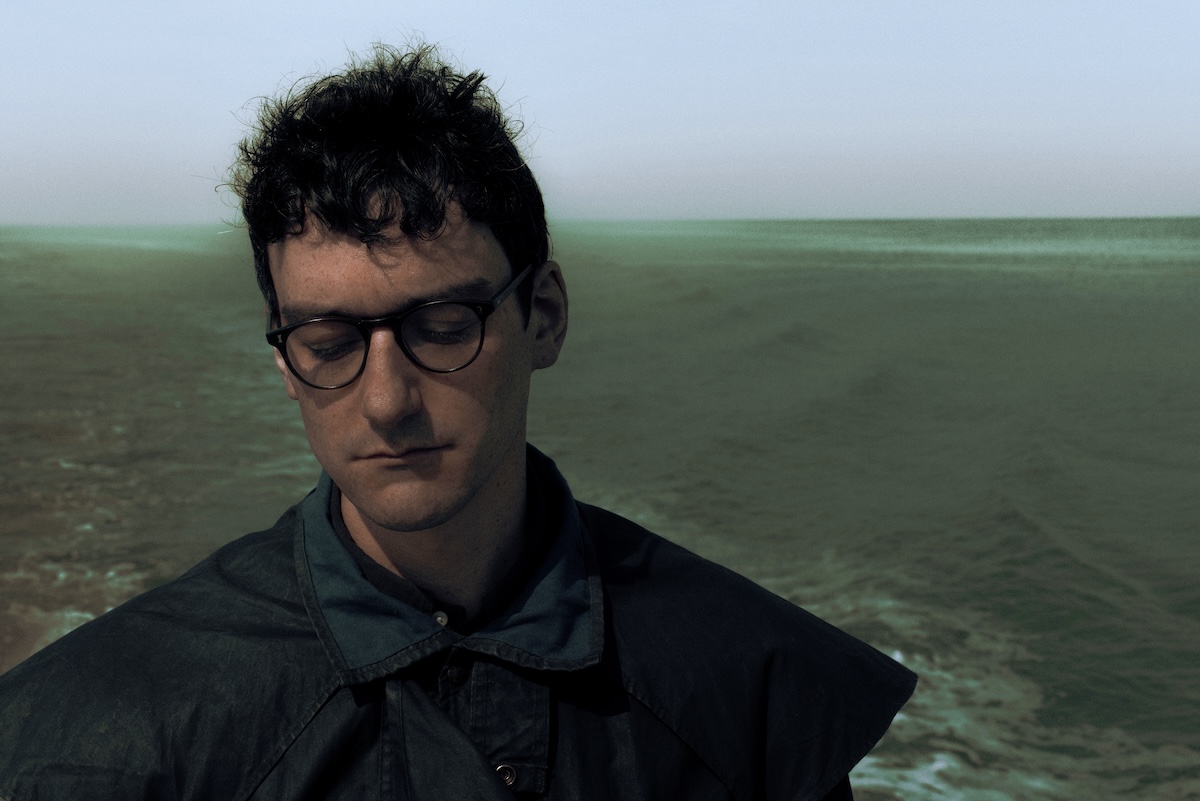
There are magical objects scattered around Danny L Harle’s studio in Hackney. A small dark silver knight wedges himself between speakers and computer monitors; a star-cloaked figurine of Merlin holds a bright orange flame aloft. Nearby are relics from the producer’s own pop mythology: a black baseball cap from Caroline Polachek’s Pang, a red cornucopia of plastic grapes recalling her “Billions” video, a CD of Dua Lipa’s Radical Optimism, a wooden box that reads “Azimuth Circle,” and a black trench coat hanging with a white buoy. The two latter objects nod to Harle’s official debut album Cerulean, out now via XL.
I meet Harle here to talk about the album four years in the making. He’s dressed in black, animated and warm, taking a brief pause from a commission for London Fashion Week. For over a decade, Harle has been a fixture in the industry, honing his pop maximalism as a co-founder of PC Music, and then going on to collaborate with countless avant-pop innovators like Polachek, Charli XCX, Yeule, and Oklou. As much as his heavy collaborative work might have kept him from prepping a solo album sooner, most of the ideas for Cerulean would not exist if not for his work with other artists like Polachek, Lipa, and Julia Michaels.
And even though Harle has already released a solo album, 2021’s Harlecore, that was billed as more of a “multimedia experience.” Harle considers Cerulean as “a musical manifesto of what I want my music to sound like.” Cerulean has been pieced together over the past four years, but the most intensive work has happened within the last year. Whereas Harlecore was a hyperfixation on happy hardcore, Cerulean is a mad scientist hybrid of classical and dance music obsessions. He describes it as his “lower concept.” Although there’s an accompanying film and recordings of the ocean that make Cerulean feel grounded in its own unique world, it’s a music-first album.
Cerulean is a mighty achievement. It’s endlessly captivating — portal-like, yet emotionally precise, capturing the incomprehensibility of superlative feeling. He loves to reference euphoric melancholy as a cornerstone of his sound. And he brilliantly captures the restlessness between emotions, oscillating between searching and serenity. There’s constant shimmering, tinselry, and a sense of climbing and reaching out.
When you hear someone’s voice, do you already know how you want to use it within your music? Or do you have to move through their artistry before you understand how to apply it?
HARLE: No, it’s much more a visceral response to their voice, and then I get a vision of what I want from it, what I would love to hear it do. Then that’s all I can offer. There has been the case with some artists where I’ve offered that and they haven’t liked it.
Your vision?
HARLE: Yeah, exactly. The stuff that everybody’s heard that I’ve done is stuff that’s obviously gone well. We recorded it and then it’s come out. There’s been lots of sessions where I’ve offered what I can and it’s not what’s required, but the thing about me is that I can only offer what I do. I’m not very versatile. It’s pretty clear if it’s going to work or not.
Do you sit and reflect on those moments?
HARLE: No. [Laughs] Cause it’s so simple. I showed them what I can offer them, and they want to go another direction. The thing that I know through experience, if I try to help them in that other direction, I just know there’s someone else who could do it better than me. So it’s actually slightly insulting, maybe selfish on my part to try and do that. I just believe that one should be in pursuit of making the best music possible. And the way I can do that is by working towards what I want to listen to.
When you said this album is a manifesto, what do you mean by that?
HARLE: This is what I want to stand by.
Is it stupid to ask you to sum that up into words?
HARLE: I guess what I mean by that is — I feel like all my other releases have been like glimpses and fragments of a sort of a certain world. I wanted to find a way of connecting up all of these different musical expressions that I’ve made in the different directions of my career.
I think a good example is when I was working with Caroline Polachek on the Pang album. It was quite revelatory to me when I was experimenting with Bruckner-styled chords from my classical training and sort of transcribing, modulating, suspending sequential chord sequences that I then, just as a pure experiment, put to the EDM supersaw sound. I realized that it created a very specific atmosphere. It took the chords that I love, and then put them through a sound that I love. I had extracted exactly the thing that I liked about the classical music and exactly the thing I liked about electronic music, and combined them in a way that didn’t detract from either. When you try and combine things, it’s more often than not, that you lose the thing that’s good about the thing in the combining, but what I wanted to do is to retain just the thing I liked and then combine it with something else.
That in itself was a step towards this album. That’s an example of the kind of experimenting I was doing for this album. I did a lot of transcribing and harmonic study and experiments to see what textures worked, to see what chords could work, to see the extent to which I could put the kind of classical things I like against the kind of dance things I like. Sometimes it doesn’t actually work to have these shifting chord sequences over dance beats, because to let dance music do its thing you kind of need a repeating chord sequence. That’s what led to the conclusion that actually maybe you could do these sort of clouds of harmonies. Like the “O Now Am I Truly Lost” track. Then with “Te Re Re” you can hear I’m doing the same kind of chord sequences, but there’s a repetition element that makes it work in dance music. So you can hear me kind of like reusing the same material over the album in different ways.
When I wrote the track in “Laa” — which is the best lyric on the album, in my opinion — that track most clearly expresses that relationship, because it starts with clouds of harmonies that are constantly modulating and then when the pan flute comes in, it sort of tames the shifting harmonies and starts repeating itself. That track is a sort of marriage of the two things that I was trying to, of the two most difficult to combine styles. When that track was done, I knew the album was done.
That’s your daughter on “Laa,” right?
HARLE: Yeah, Nico.
What was the seed of that track? You had the recording of Nico, and that inspired the world around it? Or was it another aspect that triggered it?
HARLE: That was actually my friend Matt Copson and Patrick North from XL, who advised me to have a production showcase track on the album. They said, “What about a track that focuses more on you?” So I wrote that. I wrote those chords, I wrote this sort of rock section and doing all that. But then there was a throughline missing for the track. [Plays the original recording of Nico.] That’s the one. And that was it. And I love “La” as a lyric. I love it. It’s love that it’s a child singing it as well. There’s a lot about that track that’s sort of the birth of the album in a funny way. It was almost intended to be the first track at one point.
With lyrics, is that something that’s stream-of-consciousness writing?
HARLE: Yes, completely. Completely.
It was incredibly charming to hear your daughters in your music. But then it was also really interesting reading about your music and the intense background in classical and concepts and then to have some songs that transcend words or language — it’s a cool tension.
HARLE: I mean I’m a big fan of words, but I need a certain level of distance to feel emotions a lot of the time. I really like hearing things in languages I don’t understand, for example, and also lyric-less stuff, like Meredith Monk’s Atlas. But also the track that first got me interested in Caroline Polachek’s music was the Japanese version of her song “I Belong In Your Arms.” And yeah, lyric-less, or just not understanding for some reason, draws me closer to the emotion.
Yeah, sometimes the words get in the way. Working with Caroline, how did “Azimuth” come about?
HARLE: “Azimuth” and “On & On,” they were both started during Caroline’s album process. And, as with all of my collaborations with Caroline, they were much more 50/50. Some of the tracks on the album I wrote the whole thing or most of it and then sent it off to the vocalist and they sang and sent it back or whatever. With this and all of Caroline’s stuff, she’s always completely involved and advising me with ideas. “On & On,” it was her idea to extend the second drop and have that kind of fakeout drop towards the end. It’s one of the highlights of the album.
I think she knew they were for my album before I did. But I think that’s the case with quite a lot of these songs and the artists involved. I hadn’t actually previously considered them to be part of the album, because I guess maybe when I originally envisioned the album, I quite liked the idea of having no features on it at all and having that kind of old-school dance music tradition of just having the producer’s name as a thing. But then on consideration, I realized, not only is that so unfair, and dare I say, a bit of a misogynist tradition that I’d be harking back to, [it’s also] maybe not a good idea. I realized pretty quickly that I should feature people.
Were there any tracks that were meant to be featureless and then it changed?
HARLE: Maybe in my original conception, it was more like session vocalists and stuff. But the issue was that I like very particular melodies, and there are certain singers who are the only people who can sing them. And that’s what led me to the truth of the fact that, yeah, if I had somebody else singing “Starlight,” it would sound like an imitation of Pinkpantheress. And maybe with every artist that I work with, I always try to write a song that no other artist could sing other than them.
Does it become very clear when you’re in a session with an artist and you’re like, “Okay, this is mine and this is theirs?” Or do you have a long chat about it?
HARLE: With “Azimuth,” that was the case. Yeah, it was very clearly my sort of thing that Caroline really saw something in it, and saw a reason to sort of initially outline the melody. We spent a very small amount of time just writing that melody together, and then we just went on to writing something for her project. And then we returned to it.
With Dua, we wrote that track in the first ever session I did with her. When I found out I was working with her, I wrote the instrumental for “Two Hearts” and I thought, “This is the kind of music I want to hear Dua’s voice on.” We wrote the song, me, Dua, and Andrew Wyatt. Dua loved it, but she already had the vision for her album at that point, that turned out to be Radical Optimism. Then at the end of the album, she returned to “Two Hearts” just to finish it. And it must have been because she thought it was going to go somewhere. Obviously her time is very valued, and to spend that time finishing up a song like that was much appreciated.
Were Clairo and Julia Michaels very different?
HARLE: With Clairo, that song I originally wrote to DJ as a trance song. When I wrote that chorus it really felt like there was something to be unlocked through slowing it down and letting the material breathe a bit more. And I decided that I wanted Vashti Bunyan to sing it. And then I tried to get her, and I got no response. I don’t even know if she ever heard the song. But I was sort of moaning about this backstage to Clairo at one of her shows and she said, “Ah, send it to me,” and so I sent it to her. She offered to sing it and sent me her vocals, and it was mind-blowing. Clairo is so reverent to Vashti Bunyan. I think she has a tattoo of one of Vashti Bunyan’s daughter’s designs. She so resonated with that. Clairo could have only done that track because of that very understanding.
Julia Michaels is such an incredible vocalist. That happened during one of Dua Lipa’s sessions. There was a moment where she was just humming a melody, sort of as an aside. She made a sound that never really appeared in her music — this sort of quivering, very fragile yet very, very focused melodic style that was heartbreaking even though it was lyric-less. It was so sad but in a beautiful way.
I wrote those lyrics very instinctively. She had the melody. She executed this melody perfect the first time, the sort of essence of what I’m trying to convey with the album — euphoric melancholy — which shows that she understood exactly what my musical intent is without having to talk to me about it. And It was piercing, is what it was. It showed such an understanding of what I’m after. That’s a very cool thing, and a form of communication that music allows for beyond words.
I’d never heard her sound like that.
HARLE: But in that track, it’s just quite monochromatic with sadness, which is not really like the vibe she usually goes for. She usually finds a take on sadness or an angle, but there is no angle of it in that song.
Speaking of monochromatic: Cerulean, where did that come from? Was the lyric in “Azimuth” —
HARLE: That came after. I already knew the album was called that. When I sat down to write the album, one of the tasks that I had in front of me was to draw a throughline between all my influences that go back hundreds of years to very modern stuff. Euphoric melancholy, other ideas like alien beauty and like escapism are all present in the music I love. But specifically euphoric melancholy I really associated with that cerulean color. It was also a necessary abstraction in a title that sort of hit home in the fact that it’s a music-first project, not a high-concept project. And also, I just kept on throwing, like, all my voice notes at the tracks. The ones that really stuck with me were recordings of the sea that I’d done, putting it through all these various processes, processing. And so the fact that it was also the color that’s associated with the sea, just like poetically aligned too well with the album to not call it that.
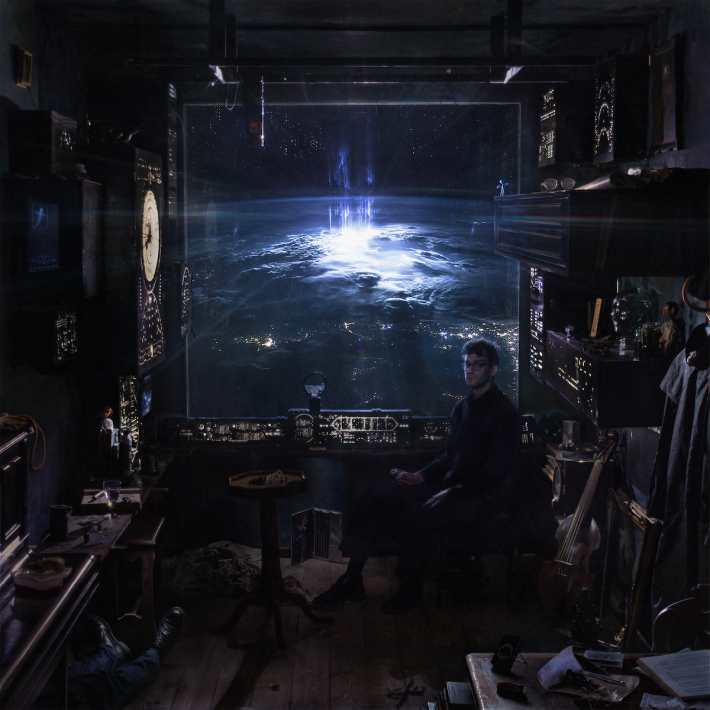
I want to hear more also about the film world and how that works into the music as well. The world that’s created has such a sci-fi, dystopian element to it. Is that a world that happens in reality, or is that taking place outside of time?
HARLE: It’s less where the album takes place, and more representing a way of listening. To me that’s a very important thing. I feel like the way one listens to music is very connected to the music one makes. The way I listen is seemingly much more internalized, and the way most of the actors is more internalized than the way I think most people do. Although that’s not necessarily true. Usually, like, journalists and fans have a similar relationship, where it’s like, headphone listening is really like the ultimate form of listening. But that’s not the case with most people.
But I just felt like it was somewhat necessary to express this feeling of individual reaction in this group setting, this feeling of alone together with people and as a reaction individually to music. That’s something I really treasure as an idea. My most profound musical experiences have been through listening on headphones or in a very dark club around other people, where it’s very much allowing me to have my own personal reaction.
I was also really inspired by the Prodigy video for “No Good.” There’s a moment where Liam Howlett is leaning against the wall like that, and then there’s someone dancing next to him like mad. I thought, “Yeah, that’s the vibe.” It’s that sort of freedom to receive music in different ways at the same place and time.
That makes a lot of sense, that push and pull between isolation and community, trying to be in your head and outside of it.
HARLE: I think that there is a special form of community that is formed through that sense of being alone together, and a recognition of people being allowed to react in their own way apart from everyone reacting the same way. I always think about the Dark Souls games as a very good example of that.
I don’t think I’ve played, but have definitely heard about them.
HARLE: They’re one of the greatest works of art, I think, of our generation. But there is a sense of you going on this single fair quest, but that you see phantoms of all these people. They’ve all left you notes as well. They’ve gone through the same journey, and you can see someone was trying to help you, someone is trying to thank you, you can see someone dying directly in front of you. Okay, so I think there’s something dangerous in front of me. It’s like, maybe an archer or something. And there’s this sense of lots of people going through the same thing over time, and you leave a note to help somebody else, but you’ll never see them. That spirit of cooperation is a very positive thing.
I wanted to ask more about working with your kids.
HARLE: Oh yeah!
Especially if you look at the core of your music as this weird tension of sadness and euphoria, and then you have something like a child’s perspective is so pure and innocent…
HARLE: When I first had children, when they were very young, I really didn’t feel any kind of profound impact on it, but then as they started to grow up and sort of wake up into the world, I started to actually realize that there was a way in which they reframe time. And it gets undoubtedly profound, just the way it makes you have to think.
And also — I mean, I’m sort of glossing over being responsible for another human life. This is from a very selfish perspective on my psyche, my creative brain — my process is actually very influenced with a sense of childlike wonder and that childhood is a very meaningful thing for me and related to my practice. And I realized that through, when there was a clear Venn diagram between elements of my children’s life and then stuff that I’m interested in as well. It’s this sense of reality being on a threshold to a dream. But children live in this world where they can totally be taken into a fantasy. They’re not even sure of what is real and what isn’t. And they’re very open to, just like, talking about mythological things and speculating about any sort of fantastical beast living around the corner or whatever. And there is that excitement, maybe that it is actually true, and that that sense of transportation and escapism really relates to the sense of transcendence quite directly that I look for.
I remember when we were in Disneyland, I was basically on the verge of tears the entire time, because there was that sense of transcending reality, really the entire time, because that’s sort of what it’s designed for. There’s these moments where the child was hugging Winnie The Pooh or whatever. There’s a moment you can tell where they just think they actually are hugging Winnie The Pooh, that threshold is crossed between reality and fantasy. And just for me, when I get a glimpse of that, yeah, it just brings me to tears every time.
Do you have moments of that when you’re creating?
HARLE: Oh, yeah, definitely, definitely. That’s how I know I’ve done my job.
Can you recall specific moments?
HARLE: When I worked out how to bring out what I wanted out of the “Facing Away” track. I slowed it down and allowed the material to kind of breathe a bit. I knew I’d done it when I’d started crying.
Is that kind of like the finalizing moment when whatever makes you so emotional?
HARLE: [Laughs] It’s very useful. It did happen to happen then, but it’s not always that simple. Sometimes it’s much more like a sort of crafting process to get to that stage, and at that point your head is so far into the craft of it that you’re not emotionally listening. But it came together quite quickly, that.
It’s so funny because that one is so minimal compared to the rest of the songs. Is it really difficult for you to be that stripped down?
HARLE: No, that’s the dream is to write at that level from simplicity. That’s the dream. I remember Sophie used to bring up all the time, the idea she’d want to write monophonic music. I immediately understood because to express yourself so clearly through monophony is the ultimate form of composition with that level of consistency.
Can you explain monophony?
HARLE: It’s like one thing — not a bassline, drum, and voice. It would be just one melody —a solo piece.
Something so pure.
HARLE: Yeah, and if you heard that, you’re like, “Oh, that’s Sophie.” That’s the ultimate form, to have such a voice that you can write in monophony.
She kind of did that.
HARLE: She certainly did! That’s why there are these things that happen — in her music you can hear the kickdrum is a bass synth in “BIPP,” she’s distilling her musical voice with the purest sounds necessary.
What do you think of cheesy music?
HARLE: I’ve never understood what that means, really. And I actually had a real dilemma when I started going to LA for the first time. [Laughs] I would have ideas, and a lot of the LA people that I collaborated with, like very mainstream pop people, were recommending things that I would consider quite cheesy or like in a way that I kind of wanted to be a part of. I never thought cheesy was bad. But then I would share an idea with them, and they’d say, “Oh no, that’s a bit corny,” which to Americans is cheesy. That blew my mind that somebody who I already thought was cheesy thought that my idea was cheesy. I just had to understand that everybody — there’s a multidimensional idea of what’s cheesy.
I was reading something, and that came up the other day and it really threw me. It made me think of, I couldn’t find the interview, but there’s some quote that’s speculating about you getting emotional over the hamster dance.
HARLE: Oh yeah, the instrumental section of “Hamster Dance.” Well, there’s a thing that I think is one of the greatest artistic achievements is to conceal something that is beautiful within something that’s goofy.
It just made me think of how I really love the Crazy Frog song. But I don’t know, it also makes me think a lot about what is good and bad taste. I don’t really believe in that, but…
HARLE: Yeah — it’s hard to know at the end of the day, though, because maybe the bad taste of it is actually a protective shield that allows you to hide in it and feel the emotions or something. I was talking to Hudson Mohawke about this kind of music that’s from where he lives, and I love a lot as well — UK hardcore music, which inspired the Harlecore project. He was talking to me about how it’s actually really aggressive dance music that has a very, very emotional melody and chord sequence. But the fact that the drum is so fast tempo kind of allows men, like masculine men, to basically listen to really emotional music without sort of fearing for their masculinity. It provides a defense shield against — they’re not listening to softer music, they’re listening to hard dance music.
I don’t need that, obviously, but it does make me think about maybe my version of that would be like, I love the feeling of there being a slight distance between me and the music, almost like the song is singing to me than the song is singing through me.
You don’t consider yourself a vessel?
HARLE: No. I consider myself a craftsman of objects.
BONUS ROUND: If you had a small miniature museum or altar showcasing yourself, what 10 objects would you choose to display?
- copy of Piranesi by Suzanne Clarke
- physical model of the “rubbish with no value” from Dark Souls, with placard description
- painting of St Michael’s Mount that I have in my studio
- one of my three-year-old daughter’s psychedelic pictures of our family
- very intricate Paul Laffoley-style diagram of all the chat and WhatsApp threads I have and their interrelation, there are frequently “casual” chats that run alongside the “serious” ones, symphonic compartmentalization
- large pile of black entangled cables
- MIDI transcription (all rectangles) of Monteverdi’s “Duo Seraphim” engraved into a 3D glass sphere
- the vinyl of “Neckbreaker” by Scott Brown given to me by DJ Buenri during my b2b with Pastis and Buenri in Barcelona
- Cerulean Receiver 2 (a device that picks up melodic transmissions – available soon)
- MC Boing bobble head
Cerulean is out now via XL.